
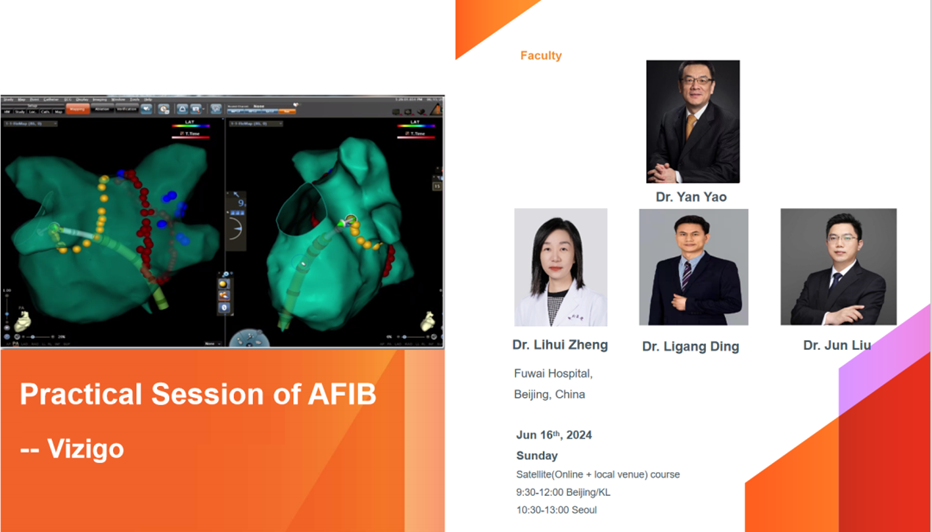
Recently, the arrhythmia expert team from Fuwai Hospital conducted an innovative English-language training session for electrophysiologists across the Asia-Pacific region. The training aimed to share Fuwai's expertise with a broader audience, fostering the development of electrophysiology in the region.
The training was led by Professor Yan Yao, along with his team members, Professors Ligang Ding, Lihui Zheng, and Jun Liu. Participants included key electrophysiologists from Sejong Hospital and Yonsei University Severance Hospital in Korea, as well as Hospital Sultanah Bahiyah in Malaysia. The training focused on the use of visualizable adjustable sheaths in atrial fibrillation procedures.
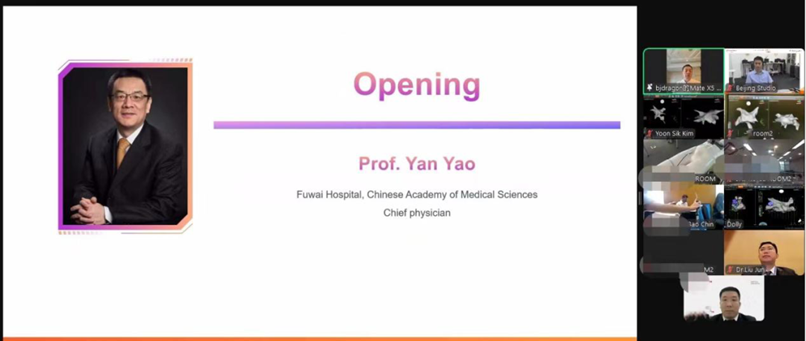
PrProfessor Yan Yao commenced the session with a welcoming speech, highlighting Fuwai Hospital's contributions to the international electrophysiology community and its commitment to innovation and talent development. He emphasized that the training aimed to share Fuwai's experiences and achievements in the use of these advanced sheaths, bringing new vitality to the electrophysiology field in the Asia-Pacific region.
Professor Lihui Zheng delivered the first lecture titled "Vizigo Features and Benefits in Afib," where he detailed the construction, working principles, and clinical application of the sheaths in atrial fibrillation treatment. Using numerous clinical cases, he vividly demonstrated the advantages of the sheaths in enhancing surgical efficiency and success rates. The attendees found the lecture deeply insightful and practical for their clinical practices.
Following this, Professor Jun Liu presented on "Workflow TSP with Vizigo," explaining the crucial steps, precautions, and the role of the sheaths in transseptal puncture procedures. Mastery of transseptal puncture is key to successful electrophysiological surgeries, and Professor Liu's detailed explanation was highly valued by the participants for improving surgical safety and precision.
In the practical session, Professor Ligang Ding used a 3D heart simulator to conduct a hands-on demonstration of the sheath-guided pulmonary vein isolation and linear ablation procedures for atrial fibrillation. He meticulously illustrated each step and detail, emphasizing the importance of real-time adjustments based on patient conditions to ensure surgical success and safety. His engaging teaching style made the complex procedures more understandable and approachable for the participants.
During the hands-on practice session, participants from the three hospitals were divided into groups to perform simulated operations under the remote guidance of Fuwai experts. Professors Zheng, Liu, and Ding provided real-time feedback and answered questions, ensuring that each participant fully grasped the operational techniques.
This training not only provided a valuable learning platform for electrophysiologists in the Asia-Pacific region but also reinforced Fuwai Hospital's esteemed position in the international electrophysiology field. Participants praised the comprehensive and practical nature of the training and expressed their desire for more such events in the future, hoping that Fuwai's techniques and experiences will continue to benefit more electrophysiologists across the region.